How it works
Perch · Nest · Twigs
How Percy works
Percy is the garden journal that remembers, so you can enjoy your garden. You just talk about it.
Free for your first growing season. No credit card.
01Ten seconds
Just talk
Hold, talk, confirm. Then back to the garden.
You just talk to Percy, because gardens are a hands-dirty, phone-in-your-back-pocket kind of thing. No navigating to a screen, filling in a form or locating your zucchini in a mile-long drop-down menu.
Hold the button.
Like a walkie-talkie. Or type, if you’d rather.
Say what you see.
Whatever comes naturally:
- “The roses are going absolutely nuts right now.”
- “Something’s eating the basil. Little holes all over the leaves.”
- “Pulled the garlic today. Biggest bulbs I’ve ever grown.”
- “The dahlias are unbelievable this year.”
Confirm.
Percy plays back what it understood: the plant, what happened, what you did. Add photos if you like, confirm, and you’re done.
You don’t need the right terminology. You’re allowed to say “um.”
Behind the scenes, Percy saves that day’s weather with your note. You’ll never have to think about it.
02Today
The Perch
One thing worth knowing today.
The Perch is the first thing you see when you open Percy: a heads-up drawn from your garden, your weather and your list. It’s also where you talk to Percy, and where you ask it anything.

Percy tells you
Frost and weather alerts for your garden.
A hard freeze tomorrow night, a heat wave, heavy rain, a dry week. Percy watches the forecast where you garden and tells you what to do about it, like bringing in the pots before a freeze.
Reminders and check-ins.
A task that’s due, or a check-in on the peas you planted two weeks ago.
You ask Percy
Garden advice based on your own garden.
The kind of question you’d otherwise Google at 2am. Percy draws on what it knows about your specific garden. So it’s not generic gardening advice for Zone 7B. It’s gardening advice based on what’s happened in your actual garden. And the advice starts organic, not in the spray aisle.
Plant, pest and disease identification by photo.
Snap a plant you don’t recognize, a leaf that looks wrong, or whatever’s been chewing on everything. Percy identifies the plant, the bug or the problem and tells you what to do next. In the US, UK, Canada and Australia, it flags natives and invasives too, and cheers you on when you pull the bad ones. Every ID is kept in your journal.
03All season
The Nest
Everything you’ve told it, kept like a book.
While you’re out in the garden telling Percy things, the Nest, your garden journal, is quietly building a record of your season. Something you’d never have the patience to make yourself, which is not a criticism, just an accurate assessment of how gardening seasons go.
The best moments open the story.
Highlights from your season live at the top: important garden updates, wildlife sightings, family moments. The ones worth a full-page spread.
Each plant gets its own chapter.
Tap any plant to see its full story. Every note, every photo, every variety, organized by date. The kind of record you’d never build yourself, assembled while you were out there gardening.
Field Notes for everything in between.
The questions you’ve asked, the IDs you requested, and anything more curious than decisive.

04What’s next
Twigs
What’s next, held for you.
Twigs is your garden planner. It holds your intentions, which are historically the things most likely to evaporate between the garden and the kitchen.
Your to-do list. Say “Remind me to fertilize these in two weeks” or “Water the garden every three days,” and Percy remembers it and nudges you when it’s time.
A private shelf for the maybe-one-day ideas: the plant you spotted on a dog walk, the new bed you’re dreaming up, the varieties you want to try next year.
This is how succession planting becomes something you actually do, rather than something you describe at dinner as something you’re going to do.
05Every couple of weeks
The Garden Letter
Your garden writes back.
 Percy to me
your first frost usually lands around oct 18
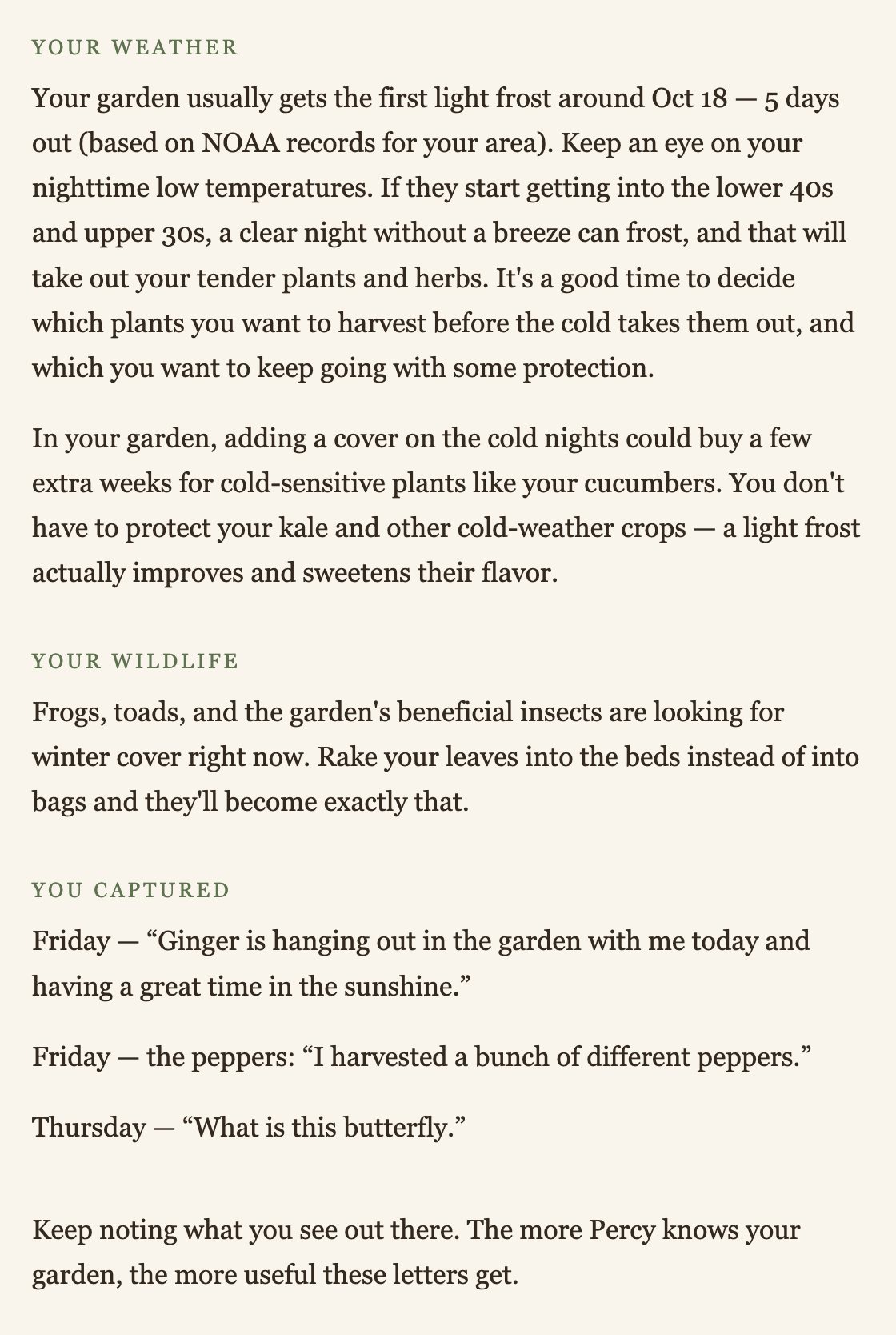
Every couple of weeks, the Garden Letter arrives by email. It brings back what you’ve noted lately, in your own words, and flags what’s coming where you live: your weather, the wildlife you spotted, and what’s on your list.
Each part shows up only when there’s something true to say. Your notes are quoted word for word, never rewritten.
06January
Migration Report
Then, in January, the story of your year.
When the season winds down, Percy writes your Migration Report: your garden’s year in review, assembled from a season of small moments you narrated while standing in the sunshine. A year of weather, every plant you grew, the visitors and the highlights, and notes for next season. With a digital edition to keep.
It arrives in the app and by email. You don’t do anything to make this happen. Percy has been building it since spring.
Your first one is part of your free season. The first Migration Reports arrive in January 2027.
07Every season
It gets better
It gets better every season.
Percy is useful from your first week. But the longer you use it, the more it has to work with.
Weeks in, it knows what you’ve forgotten.
Three weeks in, you’ll ask something you’ve already forgotten, and Percy will know the answer. You’ll start to wish you’d also mentioned where you left your keys.
You start noticing more.
Not because Percy is watching you, but because you know something is catching what you say. You start narrating things you’d normally walk past. It also bewilders the neighbors, which turns out to be its own reward too.
Next spring starts from your garden.
Every note keeps its plant, its date and that day’s weather, and your Migration Report ends with notes for next season. So you start the year from what actually happened, not a blank page.
Optional
Give it more to work with.
Percy works beautifully if all you ever do is talk to it. But if you want to give it more to work with, it’ll use every bit of it.
Your location
Percy looks up your hardiness zone and your average frost dates from the nearest NOAA weather station, and keeps a daily weather record for your garden, including measured rainfall in the US. It’s how Percy knows when to warn you about frost, and when to stop mentioning it.
Your garden layout
Share a rough sketch, a few photos, or just describe it. Percy learns your beds by name and connects every future note to a place. “The tomatoes are struggling” becomes the tomatoes in the south bed.
Your sun and shade
Tell Percy which beds get full sun and which sit in shade, and it estimates how much daylight each one gets through the seasons. The bed you’ve called “full sun” gets more usable hours in June than in March, and Percy adjusts its suggestions accordingly.
Your soil
Tell Percy what you’re working with. Heavy clay, sandy loam, acidic, amended, whatever you know. It factors this into every recommendation. “Plant dahlias” becomes “plant dahlias, and in your clay, amend with compost first.”
None of this is homework. Percy never asks you to fill out a form. It starts being useful the moment you say your first sentence.
For gardeners who’d rather be gardening.
You don’t need to use it every day. There are no streaks to keep or garden points to earn. Percy won’t nag or guilt-trip you. Just share something when it feels notable: when you plant something, notice a problem, or harvest something that made you unreasonably happy. Even thirty observations in a season gives you way more to work with next year than you’ve ever had before.
Free for your first growing season. No credit card.


Already using Percy? Here are 10 ways to get more out of it →